Thursday, March 4, 2010

Victorian Tapestry Workshop’s latest work to be displayed at 2010 Adelaide Biennial of Australian Art

Date 2010. The Victorian Tapestry Workshop's recently completed work by acclaimed Australian artist, David Noonan, has been selected by the artist to be his only work on show at the 2010 Adelaide Biennial of Australian Art.

Presented by the Art Gallery of South Australia as a part of the Adelaide Festival of Arts, the 2010 Adelaide Biennial of Australian Art: Before & After Science assembles 22 of the nation's most innovative and exciting contemporary artists and artist groups.

Following on from the critical acclaim that the Victorian Tapestry Workshop's Yvonne Todd designed Alice Bayke tapestry received in 2008 at the Queensland Art Gallery, the Tapestry Foundation of Victoria were keen to commission a work that would challenge audiences to consider tapestry beyond the accepted norms.

Director of the Victorian Tapestry Workshop, Antonia Syme said, "Contemporary tapestries are becoming more prominent on an international stage as highlighted by the recent show at the James Cohan Gallery in New York featuring 13 large scale tapestries created by internationally renowned artists and British architect Sir Norman Foster's recent purchase of a large scale Grayson Perry tapestry.

"David's growing reputation in London and his keen interest in working with tapestry made him and his work, Untitled, an obvious and exciting choice for us," says Syme.

In transforming the work's very complex imagery, the Victorian Tapestry Workshop's weavers - Cheryl Thornton, Sue Batten and Amy Cornall - have cleverly retained the most important details needed to keep the sense of uncertain narrative generated by the work as well as capture the textures and mood.

"The weavers wanted the tapestry to retain the mystery and enigmatic nature of the artwork and have been careful not to over interpret David's forms. The result is a stunning and completely engaging tapestry that both David and the Workshop are incredibly proud of," says Syme.

Untitled, measuring 2.3 x 2.93m, has become the centrepiece of the Tapestry Foundation of Victoria's collection and will be displayed around Australia to promote the Workshop and the extraordinary skills of the weavers and highlight the breadth of possibilities in contemporary tapestry.

Untitled will be on display at the 2010 Adelaide Biennial of Australian Art at the Art Gallery of South Australia from 26 February to 2 May 2010.

Friday, December 11, 2009

Merry Christmas

tapestry2008 wishes everyone a very Happy Christmas, safe holidays and a wonderful 2010, full of weaving!

The tapestry2008 blog will continue into 2010 so please forward any information to share about exhibitions, workshops and just general information that is of interest to the tapestry community at large.

Recent Museum Acquisitions of Wissa Wassef Art Centre Tapestries‏

Dashour Lake by Sayed Mahmoud


Egyptian Landscape by Ali Selim

RAMSES WISSA WASSEF ART CENTRE, EGYPT

Following the great success of the summer exhibition of Ramses Wissa Wassef Art Centre tapestries at "Nature in Art Trust", Wallsworth Hall, Gloucestershire, The Ramses Wissa Wassef Exhibition Trust is very proud to announce that the following museums have acquired large tapestries for their collections:

The British Museum

The Whitworth Art Gallery, Manchester

Bristol City Museum and Art Gallery

The Royal Albert Memorial Museum and Art Gallery, Exeter

In addition to the recent acquisitions listed here, tapestries are also held in the collections of The National Museum of Scotland, The Petrie Museum and the Victoria & Albert Museum.

The representation of the Ramses Wissa Wassef Art Centre tapestries in UK museums is something of which the Wissa Wassef weavers can be very proud.

To read about and see pictures of the acquisitions go to: Wissa Wassef
WISSA WASSEF

Thursday, November 19, 2009

WEAVERAMA


Victorian Tapestry Workshop, Melbourne.
October 2009

Workshop weaving is a demanding 9-5pm job where weavers interpret the works of artists through highly skilled, labor intensive and artistically demanding processes.
However, this exhibition gives us a window into the personal creative practices of the weavers in their own time, after workshop hours.
Sue Walker, founding director of the Victorian Tapestry Workshop, always maintained that the weavers were all artists in their own right. Their talents were obvious in the translations from artworks by other artists into woven tapestries, but their own artwork was seldom displayed in the workshop. This exhibition validates her statement by showing the diverse range of artistic practices of weavers and other staff.
The range of artwork exhibited includes woven tapestry but is varied - from mixed media to print to sculptural forms. Weaving all day, often on monumental scale works, means little time in the week is available for personal works in tapestry/the artist yearns to work in another form/returns to their original medium or experiments and develops their own highly individual style of work in tapestry.
Cheryl Thornton's finely woven miniatures are sensitive to every detail. They are understated and captivating in every pass of weft over red warp. The illusive tapestries are not facades - they are about the interaction of warp and weft, depth and a quiet appreciation of the medium.
At the opposite end of the scale Emma Sulzer's three dimensional woven training shoes at first glance say it all in a quirky humorous way. The famous brand names are resplendent worked in wool, cotton and touches of lurex.
Milly Formby's Monster Brooches are lots of fun; I expect woven as some light relief from heavy art, taking pleasure in the experimentation with materials within the small shaped pieces.
John Dicks presents plastic needlepoint, a contemporary take on the domestic craft, previously so shunned in art circles. The craft circle has come round again as we again celebrate the hand made.
The throw away materials of cardboard and newspaper are painted and arranged like a Marquette for a stage set by Lily Fraser. The freedom and abandon in this work is entirely refreshing and thinking about this work in relation to woven tapestry is very exciting.
In some previous instances workshop weavers have had their own designs woven in the workshop. This has allowed for individual creativity to flow into the weavers' day jobs. Perhaps this exhibition can again spark some weaver initiated designs and commissions for the workshop.

Valerie Kirk tapestry Weaver and Head of Textiles, ANU School of Art, Canberra.

Call for Papers


Sustainability - Issue #3
Call for academic papers documenting research that contributes to an understanding of craft and design issues in relation to sustainability.
Due date 30 June 2010
he Carbon issue - Sustainability in craft and design

What is the impact of climate change on craft and design practice?

This issue welcomes academic papers documenting research that contributes to an understanding of craft and design issues in relation to sustainability.

Green thumbprint

In terms of carbon emissions, craft production is not in the same league as coal electricity generation or jet travel. Yet with recognition of over-consumption as a problem in rich countries, questions are raised about the continuing production of non-essential goods. Is the handmade an exception? How?

Are there ways of developing a 'green thumbprint' that can reduce the environmental load of craft production, particularly kiln-based processes in ceramics and glass? Are there important efficiencies in new technologies that involve processes such as on-demand printing and customisation?

Craft ethic

Alternatively, does the ethic of the handmade provide an alternative to over-consumption, say by encouraging a culture of repair rather than replacement? Does the hand-made basis of craft provide an alternative route to escape dependency on fossil fuel? How can craft production engage with this today?

Much design in recent years has involved out-sourcing labour to manufacturing bases in Asia. What role might a concept of 'product miles' play in promoting local production? How can the return to local avoid a narrowing of diversity and creative insularity?

Aesthetics of the new green economy

In contrast to the 'clouds' of virtual exchange infiltrating work life, climate change re-focuses attention on the material world as the inevitable basis for life. In today's ecological imagination, carbon looms as a dangerous substance that needs capture to prevent it suffocating the world. Does this affect the aesthetics of carbon? How does this influence the way we look at objects in wood, or stones such as diamonds?

Papers due by 30 June 2010.

Kevin Murray is Guest Editor for this issue.

Inquiries, contact Kevin Murray at kevin [at] craftunbound.net

Or Jenny Deves at jenny.deves [at] craftaustralia.org.au

To submit papers please register online

For journal announcements and calls for papers

For author guidelines


Craft Australia Research Centre call for papers.

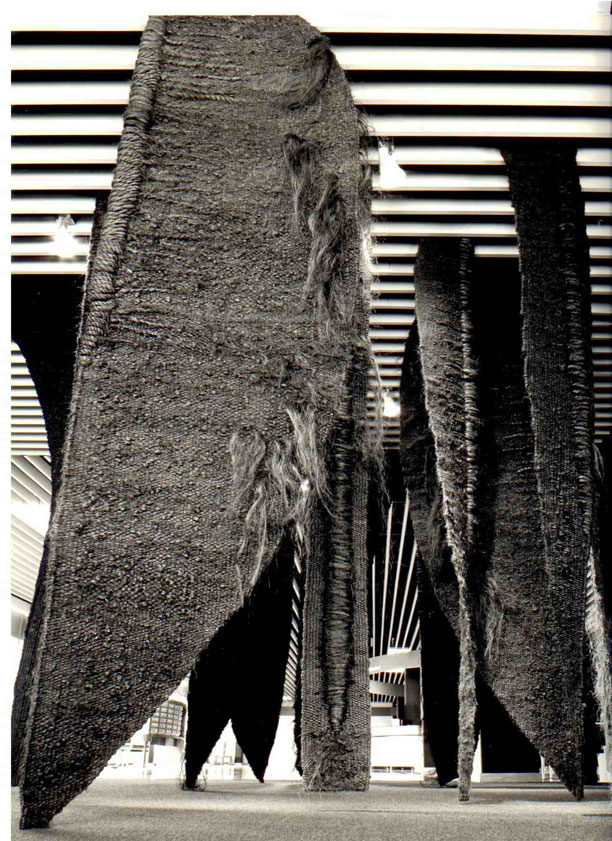
Magdalena Abakanowicz and Craft Australia


Abakan Brunne c.1970 Warsaw / Poland
Textile, dyed sisal
Technique: high warp loom-woven, pieced and sewn
Primary Insc: signed M.ABAKANOWICZ in paint on black suede leather strip sewn to lower left front of 43061.1
309.0 h x 306.0 w x 46.0 d cm
299.0 h x 278.0 w x 46.0 d cm
Accn No: NGA 76.1318.A-B

The above information was taken from the National Gallery of Australia's website.


These image are from a collection found in the Craft Australia archives. I believe these images were taken at an exhibition held in Australia in the 1980's. The collection of images have been given to the National Gallery of Australia as they hold work/s made by Abakanowicz.
I will investigate this and get information on each image.

Abakanowicz, Magdalena (b Felenty, nr. Warsaw, 20 June 1930). Polish abstract sculptor, the pioneer and leading exponent of sculpture made from woven fabrics. Initially she worked in conventional media in painting and sculpture, but from 1960 she concentrated on textiles, using hessian and rope (in some works she has also incorporated wood). Sometimes she obtained her raw materials by visiting Poland's Baltic ports and collecting old ropes, which she then unravelled and dyed. At first she made reliefs, but she soon moved on to large three-dimensional works. In 1962 she first exhibited in the West (at the International Tapestry Biennial in Lausanne) and thereafter her work appeared often outside Poland in both solo and group shows, winning her an international reputation and numerous awards.

Information about Magdalena from encyclopedia.com
This link also has a number of you tube links of Magdalenas' work and an interview with the artist.

For Sale: A new collection of wool and cotton tapestries


RAMSES WISSA WASSEF ART CENTRE

HARRANIA, EGYPT

FOR SALE

A NEW COLLECTION OF WOOL AND COTTON TAPESTRIES

Eight new wool tapestries and eight new cotton weavings for sale have been added to the Ramses Wissa Wassef Art Centre website

Hurry to visit Wissa-Wassef Arts to view the collection.